Showing posts with label ATXmega. Show all posts

Sunday, May 6, 2012

Xmega A1 Media Player development board

Features of this development board:
  1. Main controller ATxmega64A1/ATxmega128A1/ATxmega64A1u/ATxmega128A1u.
  2. On-board External 512KB SRAM memory ( AS6C4008 ).
  3. One or two onboard 24c EEPROM ICS up to 2Mb, or 23K serial RAM memory, or combined.
  4. One or two onboard uSD memory card sockets, with led to indicate activity of each uSD memory card.
  5. On-board usart to USB converter ( FT232RQ), with RX/TX activity led.
  6. On-board dedicated battery charger controller via USB connector ( MCP73871 ).
  7. On-board dedicated resistive touch screen controller ( AR1020 ).
  8. On-board dedicated RTC/64Bytes SRAM/128Bytes EEPROM circuit with backup high capacity capacitor ( MCP79410 ).
  9. On-board Ogg Vorbis/MP3/AAC/WMA/MIDI codec ( VS1053b ) with jack 3.5mm audio output ,3 pin connector audio input and connector for button style Microphone, with led activity monitor on xDCS, xCS and and DREQ pins.
  10. 320x240 TFT high quality display 8Bit bus mode ( MI0283QT-2 ) connected to external SRAM bus to increase speed of transaction using DMA working with him like a external SRAM.
  11. One 30 pin extension peripheral connector with bidirectional 8bit data bus, unidirectional 8Bit A0-A7 address bus,7 chip select signals, RW and RD signals and one IRQ line.
  12. On-board bus extension decoder to allow up to seven external peripherals directly accessed via external RAM bus ( 74LV138 ) and up to 256*7 external peripherals with external addresses decoders.
  13. One lateral push button user defined(like PWR/Back).
  14. One lateral push button reset function.
  15. PDI programing connector.
  16. JTAG debugging connector.
  17. 3V VLDO power regulator for all circuits, to power this board from LI-IO battery on entire range of voltage ( 3.2 to 4.2V and 5V from USB connector).
  18. 1.8V VLDO power regulator to power digital section on VS1053b circuit.
  19. On-board NOKIA or HUAVEI battery connector.
  20. Three pin connector to connect an external battery.
  21. 29 IO pins accessed via two lateral 26 pin connectors ( entire B and C port, pin port A2-A7 and D1-D7 ).
  22. Resistive divider to monitor the battery voltage.
 Down I posted several photos of board generated by a 3D software:


 In future for this board will be developed extra peripherals like:
  • ATA high capacity hard disk shield.
  • Secondary displays shield.
  • Ethernet interface shield.
  • Nand flash memory shield.
  • Video sensor shield.
  • Magnetometer shield.
  • Gyroscope shield.
  • Dedicated ADC shield to make oscilloscope.
  • Video out encoder shield.
  • Wireless communication shield.
  • GSM communication shield.
  • IR communication shield.
  • Bluetooth communication shield.
  • GPS shield.
  • Motor stepper shield.
  • Xbee shield.
And others.

This board will be delivered with a demo MP3 player project source code and a framework with library's and drivers special developed for this board.

Tuesday, January 24, 2012

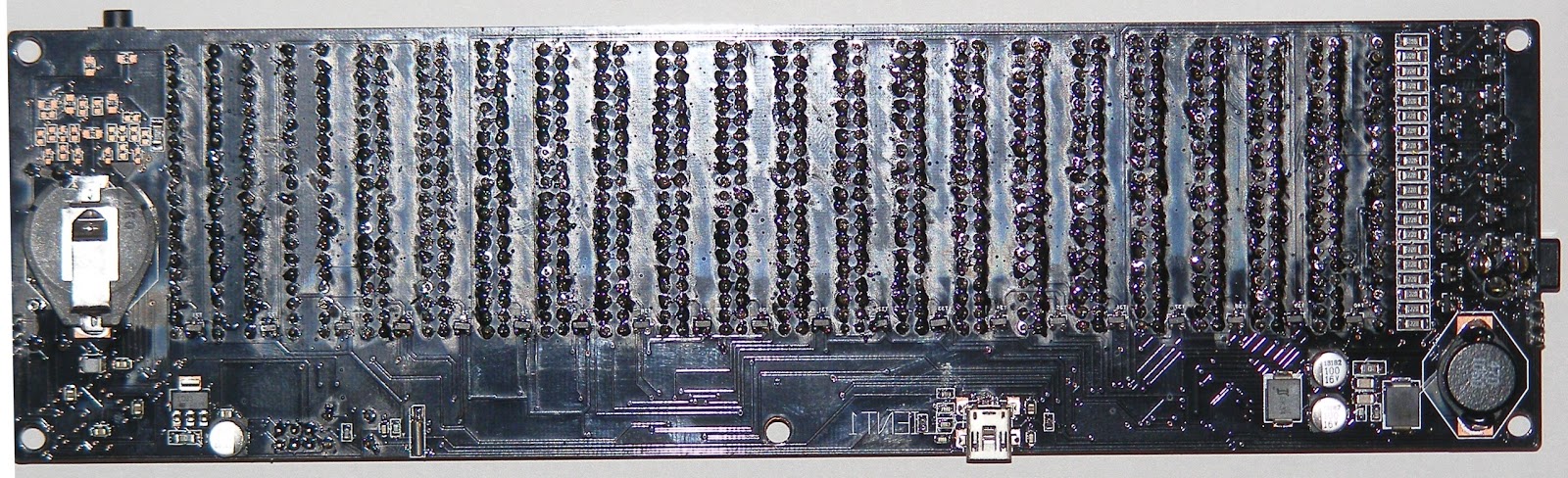
Stereo digital audio spectrum analyzer V4.0


This is a stereo upgrade of previous version 3.x.

This version has multiple changes from the previous version, like:

V 4.0A is a version with 18 Bands + Two VU meters for right and left channels.
  1. Can handle stereo signals.
  2. Display format is 18+1+1( to display 18 bands of frequencies and Left Right signal level) .
  3. USB adapter for easy upgrade.
  4. Dedicated RTC with battery back-up.
  5. Added two usart connectors to create cascade spectrum analyzers( to create large display from boards like this ).
  6. A microcontroller twice faster that previous and multiple hardware advantages that increase speed of signal processing and display rendering.
Down I posted two photos with new board design.


V 4.0B is a version with 20Bands.
A 3D presentation of Audio Spectrum Analyzer 4.0B:


Sunday, September 11, 2011

MikroMMB for Xmega MP3 Player

This project is created in AVR GCC with 100% my own drivers and libraries , this player can play MP3, WMA and OGG files from micro SD/SDHC memory card fat16/32 formatted.

V1.3

On this firmware I made some bug fixes and I adding some functions to player:

Bug fixes:

  1. The previous versions has a bug that forces user to put on first location of root directory the volume ID or a file or folder with the short name only.
Function's added:
  1. A progress bar to track the melody, with the same progress bar the user can force the audio player to play file from a specified point.
  2. Player can run now like a thread "Open player" "Close Player" when card is inserted is automatically opened the player, when SD card is removed all resources used by Audio Player will be freed.
  3. Now you can play music from SD/SDHC card's formatted in FAT16 or FAT32(The FAT16 has a little bug, on root directory is displayed only files and directory's from first Page(512Bytes).
On this version you can play: MP3, AAC, OGG, WAV and WMA.


V1.2

 On this version I made some changes:

  1. I change the navigation from the "next" "previous" button to a list box.
  2. On this version is not capable to display bitmap's because I want to design another interface to view bitmap photo.
  3. The VS chip data is send by a service that work inside the RTC interrupt service, in this case has a high priority to send data to VS chip.


Download V1.2 demo version of this player.

V1.1

On this version I made huge improvements.

  1. Now you can navigate through the directories when you listen music, you can choose another melody when you listen another melody.
  2. The player has change the listen melody with the next from the current directory, the payback is stopped after the last melody is played.
  3. Now you can see bitmaps images in 8, 24 and 32 bit/pixel with some limitations, maximum size 240x200pixels, the maximum file size 140KB (140000bytes), the 240x200 pixels limitation is implemented to no interference with the player interface, the 140KB limitation is made because I have a bug in the bitmap library, that can't read files bigger than this value.
This version is limited to play only MP3 files, the core clock is 32Mhz.


V1.0

The controller is running at 16Mhz.

On this version can't manage the power consumption.

This version can play MP3, WMA and OGG.


Tuesday, August 16, 2011

ATxmega boot loader

Currently I bought a Micromedia Board ( microMMB for XMEGA ) from mikroEelektronika.

This board is perfect for general developing because can be used by programmers that don't have a programmer, because is coming with a bootloader pre-installed.
I mentioned only the bootloader because this bootloader is the problem
To upload a flash with 64KB size is taken about 10-15 minutes, or to develop a firmware is a very very long time to wait, visualizing this I developed a very fast bootloader to write only Flash and EEProm memory, only strictly necessary memories because all of other ATxmega features can be set from uploaded firmware.

In this stage I compiled eight bootloader firmwares only for ATxmega128A1 for each used hardware usart, and each firmware work with a 256000 baud transfer rate, this baud rate is set like default baud rate for the up-loader when is opened, I want to mention that the up-loader can work with atmega bootloader firmwares found here.

Version 1.0 of firmwares:

For usart 6 ( usart F0 ). can be used for Micromedia Board for XMEGA.


Tuesday, May 17, 2011

Multipurpose development board with ATxmega64A1 / ATxmega128A1


Features:
  1. Main processing unit ATxmega64A1 or ATxmega128A1.
  2. Audio decoder VS1011,1033,1053 with stereo jack 3.5mm female connector & external speakers 3 pin connector(optional).
  3. DS1307 real time clock with battery pads.
  4. PDI & JTAG connectors.
  5. LB1936 dual driver for asynchronous motors (optional).
  6. AD7414 temperature sensor for motor driver (optional).
  7. External motors driver connector with I2C bus.
  8. Two micro SD connectors ( one is optional ).
  9. Four connectors with 2x3 pin to control eight servo motors, two servomotors for each connector, each connector is power interruption to minimize power consumption.
  10. Two power jack connector 5.5/2.1mm put in series to connect two photovoltaic panels and with static commutator controlled by software to charge main accumulator.
  11. High power step down stabilizer from accumulator voltage to 3.3V.
  12. On-board 512KB static ram for minimizing power consumption in sleep mode.
  13. BTM-222 Bluetooth for communication with PC or mobile phones (optional).
  14. RFM12BP at 434Mhz for communication with one remote control for huge distance up to 5Km (optional).
  15. RFM12BS at 868Mhz to control other wireless modules (optional).
  16. All modules from point 13, 14 & 15 can work at the same time without interferences.
  17. Five connectors with four pins with I2C bus and 3.3V power for future extensions.
  18. External extension bus connector to connect future external modules to ATxmega parallel data bus, such as Displays, more motors controllers, image sensors etc.
  19. Possibility to monitor power consumption from main accumulator.
  20. Possibility to monitor generated power by the photovoltaic panels.
  21. Possibility to monitor voltage of the main accumulator.
  22. Possibility to monitor power consumption of each motor powered by on-board driver.
Applications:
  1. Robots: contain on-board dual asynchronous motor driver and four connectors to control eight servomotors, powered from an Li-Ion accumulator and support to charge the accumulator from two photovoltaic cells or from an external source, several communication modules: Bluetooth Class1, EFM12BP for long distance communication up to 5Km and RFM12BS for low power and short distance communication up to 300m.
  2. Audio player: contain on-board VS1011, VS1033 or VS1053, single or dual micro-SD memory card connectors with push.
  3. Audio/Video(low quality) player.
  4. General development application because has all possibility to connect with another controller or another peripherals to the expansion bus, the expansion connector work to speed of the external ram memory, because the expansion peripherals is mapped to address space 524288 to 1048576, maximum number of expansion peripherals is 65536.


Power supply input between 3.4V and 9.5V
Maximum supported input voltage on photovoltaic connectors and the main accumulator: 9.5V, Maximum absolute 10.5V.
Board dimension: 66.83 x 130.78mm.

Sunday, February 20, 2011

Development board 1 for ATXMEGA A1 microcontrollers

This is a very simple board to test and develop firmwares for ATXMEGA A1 micro-controllers.

This board contains only strictly necessary components for the ATXMEGA A1 micro-controller and only one extra module is added, the USB to serial adapter, the rest of modules can be added to a mother board.

This board has 89x74mm.


This is a very simple board to test and develop firmwares for ATXMEGA A1 micro-controllers.

This board contains only strictly necessary components for the ATXMEGA A1 micro-controller and only one extra module is added, the USB to serial adapter, the rest of modules can be added to a mother board.

This board has 89x74mm.


You can download gerber files and schematic from here.